
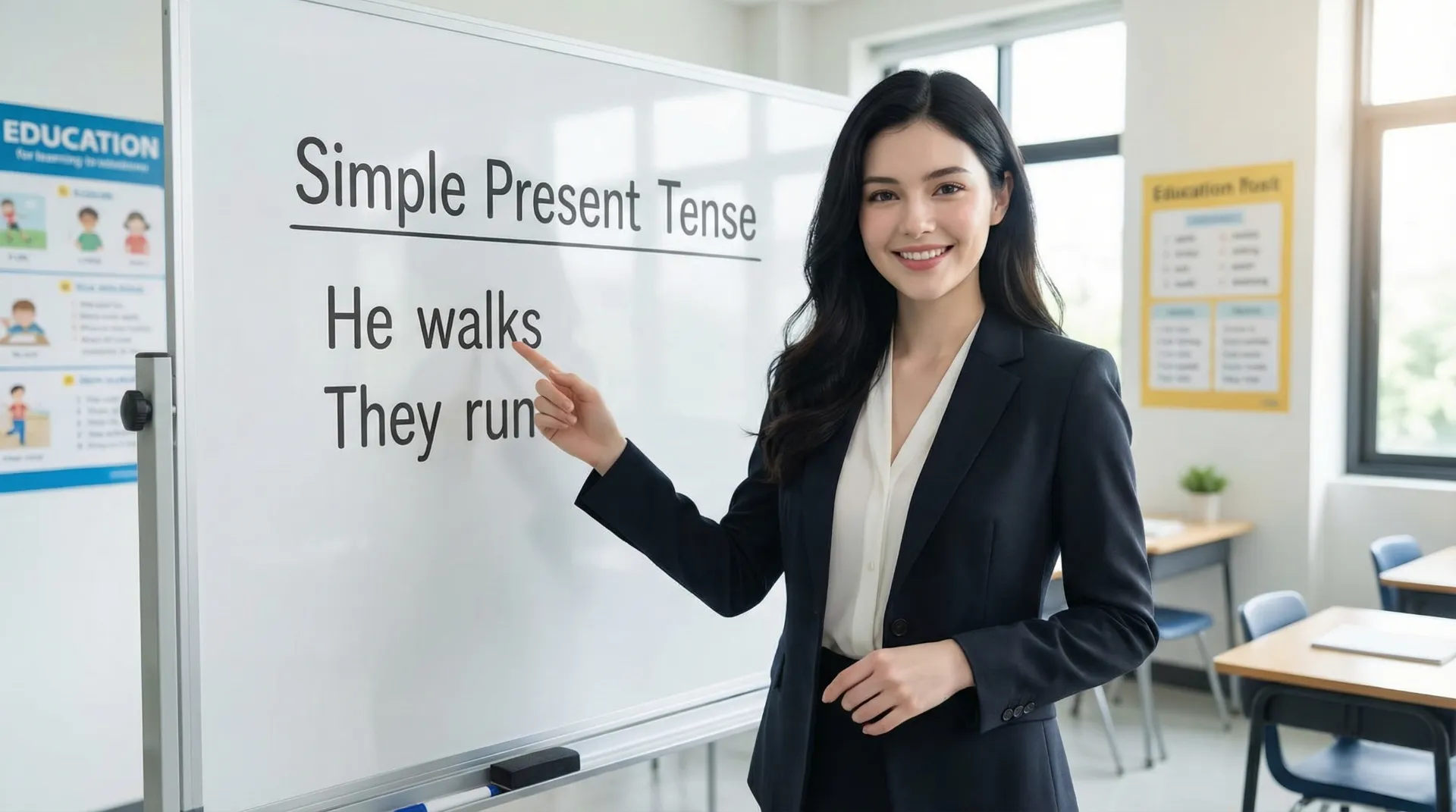
Simple Present Tense คืออะไร? #
Simple Present Tense หรือ ปัจจุบันกาลธรรมดา เป็น Tense ที่ใช้บ่อยที่สุดในภาษาอังกฤษ ใช้สำหรับพูดถึงสิ่งที่เกิดขึ้นเป็นประจำ นิสัย ข้อเท็จจริง และความจริงทั่วไป สำหรับผู้เริ่มต้นเรียนภาษาอังกฤษ การเข้าใจ Simple Present เป็นขั้นตอนแรกที่สำคัญมาก
Simple Present = สิ่งที่ทำเป็นประจำ + ข้อเท็จจริง + ความจริงทั่วไป
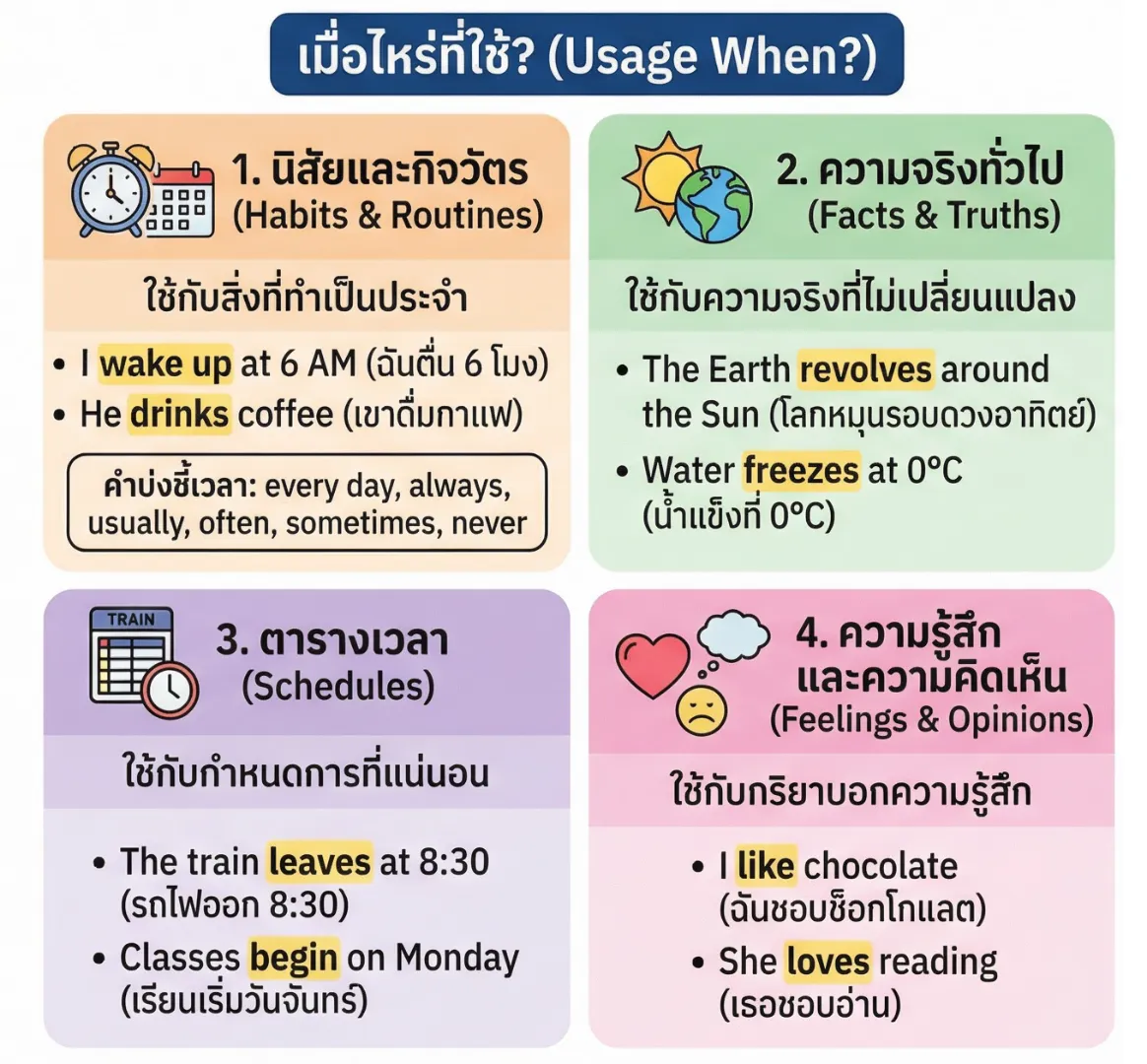
เมื่อไหร่ที่ใช้ Simple Present Tense #
1. นิสัยและกิจวัตรประจำวัน (Habits and Routines) #
ใช้เมื่อพูดถึงสิ่งที่เราทำเป็นประจำทุกวัน ทุกสัปดาห์ หรือทุกเดือน
ตัวอย่าง:
- I wake up at 6 AM every day (ฉันตื่นนอนเวลา 6 โมงเช้าทุกวัน)
- He drinks coffee every morning (เขาดื่มกาแฟทุกเช้า)
- We go to the gym three times a week (เราไปฟิตเนสสัปดาห์ละ 3 ครั้ง)
- They visit their grandparents on Sundays (พวกเขาไปเยี่ยมปู่ย่าตายายทุกวันอาทิตย์)
คำบ่งชี้เวลา:
- every day (ทุกวัน)
- every week/month/year (ทุกสัปดาห์/เดือน/ปี)
- always (เสมอ)
- usually (มักจะ)
- often (บ่อยๆ)
- sometimes (บางครั้ง)
- never (ไม่เคย)
2. ข้อเท็จจริงและความจริงทั่วไป (Facts and General Truths) #
ใช้กับสิ่งที่เป็นความจริงที่ไม่เปลี่ยนแปลง
ตัวอย่าง:
- The Earth revolves around the Sun (โลกโคจรรอบดวงอาทิตย์)
- Water freezes at 0 degrees Celsius (น้ำแข็งตัวที่ 0 องศาเซลเซียส)
- Cats love fish (แมวชอบปลา)
- Thailand is in Southeast Asia (ประเทศไทยอยู่ในเอเชียตะวันออกเฉียงใต้)
- Dogs bark (สุนัขเห่า)
3. ตารางเวลาและกำหนดการ (Schedules and Timetables) #
ใช้กับเหตุการณ์ที่มีกำหนดการแน่นอน
ตัวอย่าง:
- The train leaves at 8:30 AM (รถไฟออกเวลา 8:30 น.)
- The movie starts at 7 PM (หนังเริ่มเวลา 7 ทุ่ม)
- The store opens at 9 AM (ร้านเปิดเวลา 9 โมงเช้า)
- Classes begin on Monday (คลาสเรียนเริ่มวันจันทร์)
4. ความรู้สึกและความคิดเห็น (Feelings and Opinions) #
ใช้กับกริยาที่แสดงความรู้สึก ความคิดเห็น การรับรู้
ตัวอย่าง:
- I like chocolate (ฉันชอบช็อกโกแลต)
- She loves reading books (เธอรักการอ่านหนังสือ)
- He knows the answer (เขารู้คำตอบ)
- They believe in hard work (พวกเขาเชื่อในการทำงานหนัก)
- We understand the problem (เราเข้าใจปัญหา)
โครงสร้างประโยค Simple Present #
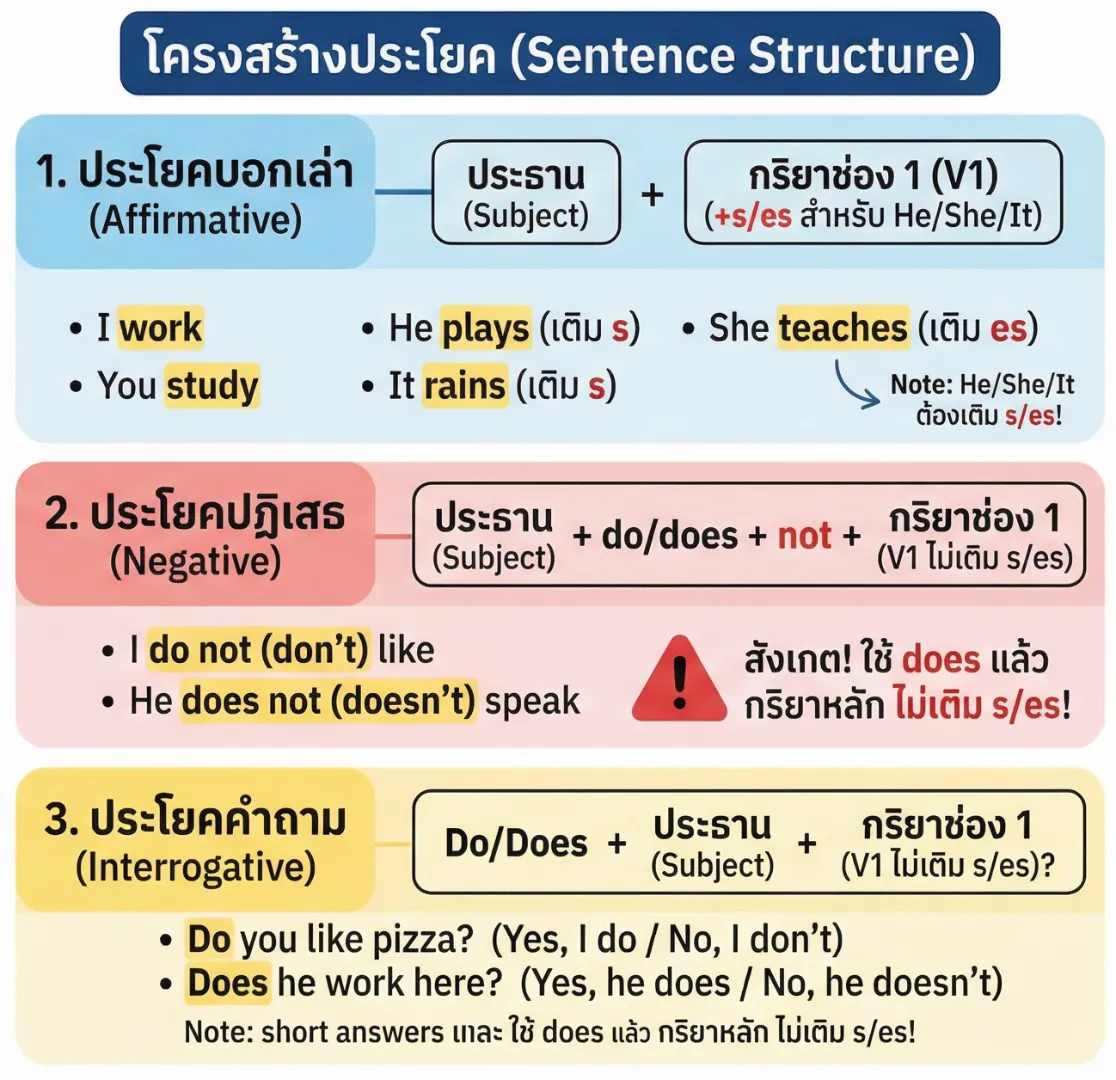
1. ประโยคบอกเล่า (Affirmative Sentences) #
โครงสร้าง:
ประธาน + กริยาช่อง 1 (+ s/es สำหรับ he/she/it) + กรรม
Subject + Verb (+ s/es for he/she/it) + Object
ตัวอย่าง:
- I work in Bangkok (ฉันทำงานในกรุงเทพฯ)
- You study English (คุณเรียนภาษาอังกฤษ)
- He plays football (เขาเล่นฟุตบอล) ← เติม s
- She teaches Math (เธอสอนคณิตศาสตร์) ← เติม es
- It rains a lot here (ที่นี่ฝนตกบ่อย) ← เติม s
- We live in Thailand (เราอยู่ในประเทศไทย)
- They eat rice every day (พวกเขากินข้าวทุกวัน)
2. ประโยคปฏิเสธ (Negative Sentences) #
โครงสร้าง:
ประธาน + do/does + not + กริยาช่อง 1 (ไม่เติม s/es) + กรรม
Subject + do/does + not + Verb (base form) + Object
ตัวอย่าง:
- I do not (don’t) like coffee (ฉันไม่ชอบกาแฟ)
- You do not (don’t) need help (คุณไม่ต้องการความช่วยเหลือ)
- He does not (doesn’t) speak Thai (เขาไม่พูดภาษาไทย)
- She does not (doesn’t) eat meat (เธอไม่กินเนื้อ)
- It does not (doesn’t) work (มันไม่ทำงาน)
- We do not (don’t) watch TV (เราไม่ดูทีวี)
- They do not (don’t) play games (พวกเขาไม่เล่นเกม)
สังเกต: เมื่อใช้ does กับ he/she/it แล้ว กริยาจะไม่เติม s/es อีก!
3. ประโยคคำถาม (Interrogative Sentences) #
โครงสร้าง:
Do/Does + ประธาน + กริยาช่อง 1 (ไม่เติม s/es) + กรรม?
Do/Does + Subject + Verb (base form) + Object?
ตัวอย่าง:
- Do you like pizza? (คุณชอบพิซซ่าไหม?)
- Yes, I do / No, I don’t
- Do they live in Bangkok? (พวกเขาอยู่กรุงเทพฯ ไหม?)
- Yes, they do / No, they don’t
- Does he work here? (เขาทำงานที่นี่ไหม?)
- Yes, he does / No, he doesn’t
- Does she speak English? (เธอพูดภาษาอังกฤษไหม?)
- Yes, she does / No, she doesn’t
- Does it rain in winter? (ฤดูหนาวฝนตกไหม?)
- Yes, it does / No, it doesn’t
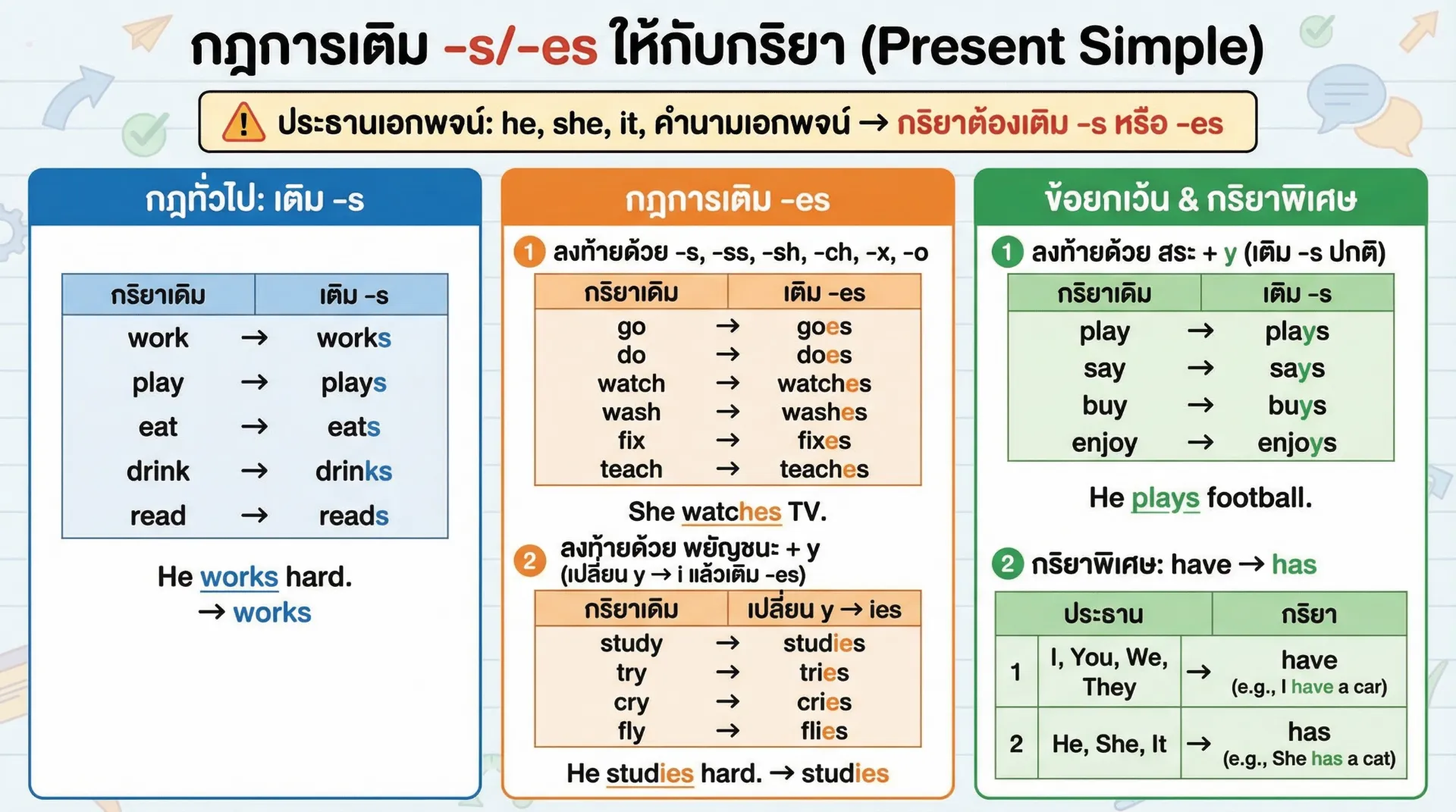
กฎการเติม -s/-es ให้กับกริยา #
นี่คือส่วนที่คนไทยมักสับสน! เมื่อประธานเป็น he, she, it หรือคำนามเอกพจน์ ต้องเติม -s หรือ -es ให้กับกริยา
กฎการเติม -s (ส่วนใหญ่) #
กฎทั่วไป: เติม -s ลงท้ายกริยา
| กริยาเดิม | เติม -s | ตัวอย่างประโยค |
|---|---|---|
| work | works | He works hard |
| play | plays | She plays piano |
| eat | eats | It eats fish |
| drink | drinks | He drinks tea |
| read | reads | She reads books |
กฎการเติม -es #
กฎที่ 1: กริยาที่ลงท้ายด้วย -s, -ss, -sh, -ch, -x, -o ให้เติม -es
| กริยาเดิม | เติม -es | ตัวอย่างประโยค |
|---|---|---|
| go | goes | He goes to school |
| do | does | She does homework |
| watch | watches | He watches TV |
| wash | washes | She washes dishes |
| pass | passes | It passes quickly |
| fix | fixes | He fixes computers |
| teach | teaches | She teaches English |
กฎที่ 2: กริยาที่ลงท้ายด้วย พยัญชนะ + y ให้เปลี่ยน y เป็น i แล้วเติม -es
| กริยาเดิม | เปลี่ยน y → ies | ตัวอย่างประโยค |
|---|---|---|
| study | studies | He studies hard |
| try | tries | She tries her best |
| cry | cries | The baby cries |
| fly | flies | The bird flies |
| carry | carries | He carries a bag |
ข้อยกเว้น: ถ้าลงท้ายด้วย สระ + y ให้เติม -s ปกติ
| กริยาเดิม | เติม -s | ตัวอย่างประโยค |
|---|---|---|
| play | plays | He plays football |
| say | says | She says hello |
| buy | buys | He buys food |
| enjoy | enjoys | She enjoys music |
กริยาพิเศษ: have → has #
| ประธาน | กริยา | ตัวอย่าง |
|---|---|---|
| I, You, We, They | have | I have a car |
| He, She, It | has | She has a cat |
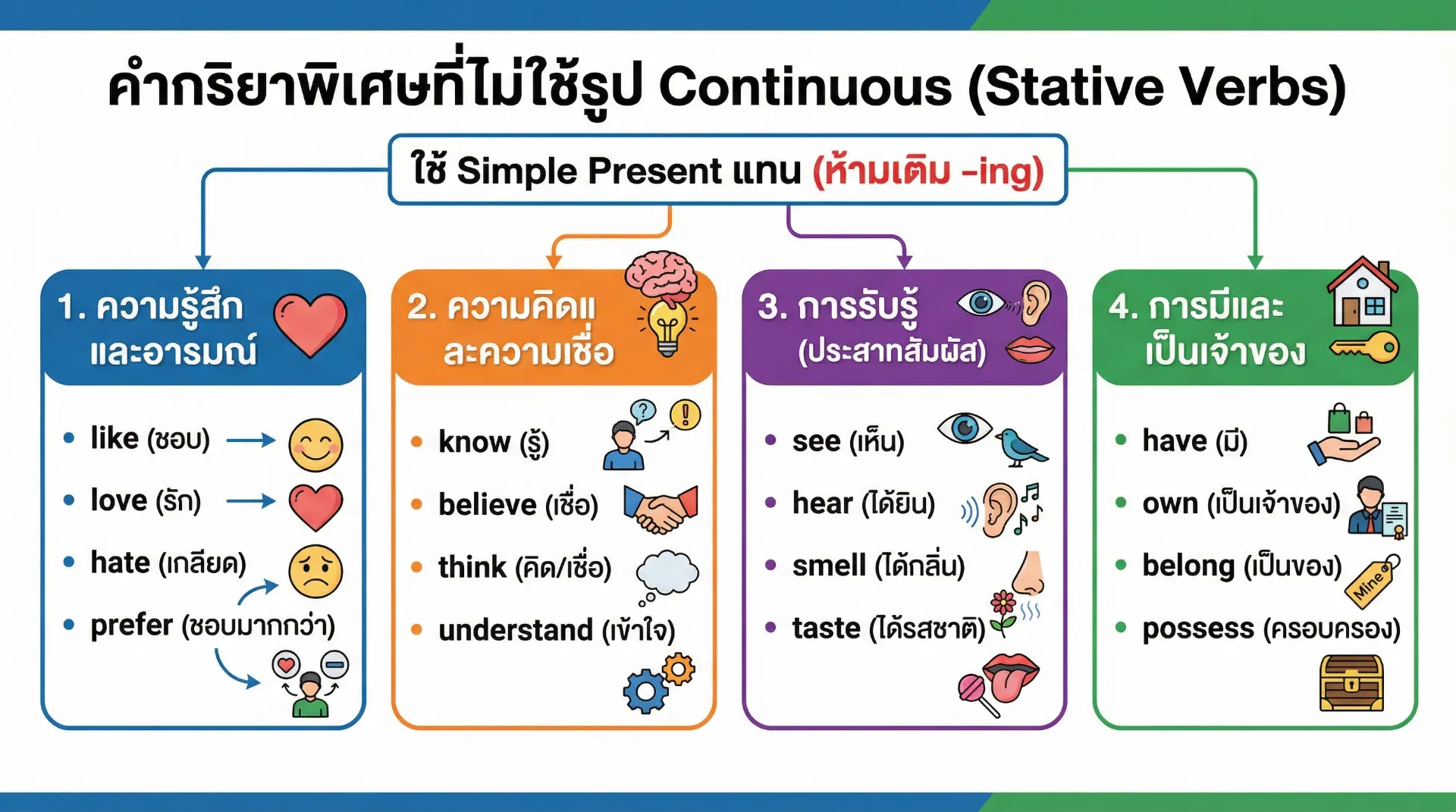
คำกริยาพิเศษที่ไม่ใช้รูป Continuous #
กริยาบางตัวไม่สามารถใช้รูป -ing (Present Continuous) ได้ เราใช้ Simple Present แทน:
1. กริยาแสดงความรู้สึกและอารมณ์ #
- like (ชอบ) - I like coffee
- love (รัก) - She loves chocolate
- hate (เกลียด) - He hates vegetables
- prefer (ชอบมากกว่า) - They prefer tea
2. กริยาแสดงความคิดและความเชื่อ #
- know (รู้) - I know the answer
- believe (เชื่อ) - She believes in you
- think (คิด/เชื่อ) - He thinks it’s true
- understand (เข้าใจ) - We understand the problem
3. กริยาแสดงการรับรู้ #
- see (เห็น) - I see a bird
- hear (ได้ยิน) - She hears music
- smell (ได้กลิ่น) - It smells good
- taste (ได้รสชาติ) - This tastes delicious
4. กริยาแสดงการมีและเป็นเจ้าของ #
- have (มี) - I have two brothers
- own (เป็นเจ้าของ) - She owns a house
- belong (เป็นของ) - It belongs to me
- possess (ครอบครอง) - He possesses skills
ข้อผิดพลาดที่คนไทยมักทำ #
❌ ผิดพลาด #1: ลืมเติม -s/-es กับ he/she/it #
ผิด:
❌ He go to school
❌ She like ice cream
❌ It work well
ถูก:
✅ He goes to school
✅ She likes ice cream
✅ It works well
❌ ผิดพลาด #2: เติม -s/-es กับ I/You/We/They #
ผิด:
❌ I goes to work
❌ They likes music
❌ We watches TV
ถูก:
✅ I go to work
✅ They like music
✅ We watch TV
❌ ผิดพลาด #3: เติม -s/-es ในประโยคปฏิเสธและคำถาม #
ผิด:
❌ He doesn’t likes coffee
❌ Does she speaks Thai?
ถูก:
✅ He doesn’t like coffee 👍 (ไม่เติม s เพราะมี doesn’t แล้ว)
✅ Does she speak Thai? 👍 (ไม่เติม s เพราะมี does แล้ว)
❌ ผิดพลาด #4: ใช้ do กับ he/she/it #
ผิด:
❌ He do not work here
❌ Do she like pizza?
ถูก:
✅ He does not work here
✅ Does she like pizza?
❌ ผิดพลาด #5: สับสนระหว่าง have และ has #
ผิด:
❌ She have a car
❌ He have two sisters
ถูก:
✅ She has a car
✅ He has two sisters
เทคนิคจำง่ายสำหรับคนไทย #
🎯 เทคนิค 1: จำคำว่า “เฮ-ชี-อิท มีเอส” #
เมื่อประธานเป็น He, She, It (เฮ-ชี-อิท) ต้องเติม -s/-es!
🎯 เทคนิค 2: สร้างประโยคจากชีวิตจริง #
ฝึกสร้างประโยคจากกิจวัตรของตัวเอง:
- I wake up at 7 AM
- I eat breakfast at 8 AM
- I go to work at 9 AM
- I have lunch at 12 PM
🎯 เทคนิค 3: ใช้การ์ดท่องจำ (Flashcards) #
สร้างการ์ดคำศัพท์:
- ด้านหน้า: play
- ด้านหลัง: plays, doesn’t play, Does…play?
สรุป #
Simple Present Tense เป็นพื้นฐานสำคัญของภาษาอังกฤษ จำสิ่งเหล่านี้ให้ขึ้นใจ:
✅ ใช้เมื่อ: นิสัย, ข้อเท็จจริง, ตารางเวลา, ความรู้สึก
✅ โครงสร้าง: ประธาน + กริยา (เติม s/es กับ he/she/it)
✅ ปฏิเสธ: ใช้ don’t/doesn’t + กริยาช่อง 1
✅ คำถาม: Do/Does + ประธาน + กริยาช่อง 1
✅ จำไว้: เติม -s/-es เฉพาะกับ he/she/it ในประโยคบอกเล่าเท่านั้น!
ฝึกฝนทุกวันและคุณจะเก่งแน่นอน! 💪
แบบฝึกหัด #
แบบฝึกหัดที่ 1: เติม -s/-es ให้ถูกต้อง
แบบฝึกหัดที่ 2: สร้างประโยคปฏิเสธ
แบบฝึกหัดที่ 3: สร้างประโยคคำถาม
แบบฝึกหัดที่ 4: แก้ไขประโยคที่ผิด
เรียนต่อในซีรีส์ #
- 📘 Present Tense ภาษาอังกฤษ: เรียนรู้ไวยากรณ์พื้นฐาน
- 📗 Present Continuous Tense: เมื่อไหร่ที่ใช้ -ing (เร็วๆ นี้)
- 📕 Present Perfect Tense: ความต่างระหว่าง have และ has (เร็วๆ นี้)
เริ่มฝึกตอนนี้และพัฒนาทักษะภาษาอังกฤษของคุณ! 🚀